Over the past decade, support for entrepreneurs in North Africa has been evolving. Small pilot initiatives have gradually given way to larger national programs designed to help businesses grow and create jobs across the region.
At the center of this evolution is EInA (Employment Innovations and Advice for North Africa), a platform created by the African Development Bank (AfDB) to strengthen entrepreneurship and employment policies and programs.
EInA’s transformation did not happen overnight. It emerged through a gradual process shaped by practical experience, evidence and continuous learning from early initiatives on the ground. Each stage helped refine the approach, moving from support to individual entrepreneurs toward building stronger systems and scalable programs capable of delivering wider and more sustainable impact.
The Beginning: Souk At-Tanmia
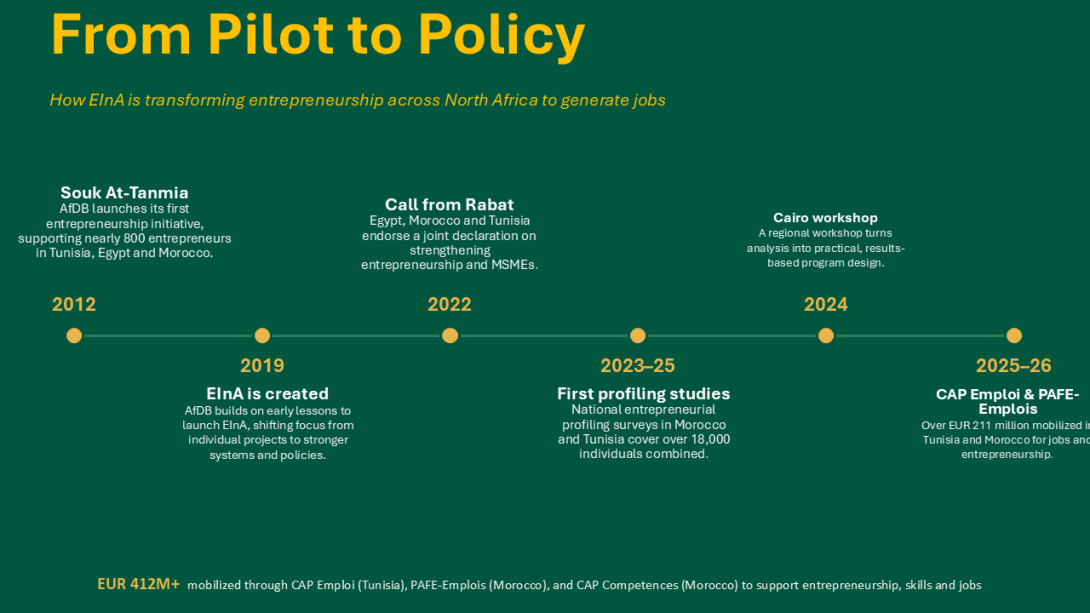
The journey began in 2012 with Souk At-Tanmia, an initiative launched by the AfDB to support entrepreneurs in North Africa. The Arabic name means “Market of Development,” reflecting the idea that entrepreneurship can create opportunities for individuals and communities alike. Over the following years, the initiative directly supported almost 800 entrepreneurs across Tunisia, Egypt and Morocco. These projects helped many businesses start or expand yet at the same time, they revealed an important lesson.
Supporting entrepreneurs through individual projects could make a difference for many people, but it was not enough to transform employment opportunities across entire economies. What the region needed was not only support for entrepreneurs themselves, but stronger policies, institutions and financing systems that could reach far more businesses. These early lessons helped shape the next stage.
The Creation of EInA
In 2019, the AfDB launched EInA, building directly on the lessons learned from Souk At-Tanmia.
The platform was designed to move beyond individual projects and focus on strengthening the systems that support entrepreneurship and job creation. EInA works with governments and partners to improve policies and help design programs that are sustainable and can be scaled across the region. This marked the next phase in the evolution of entrepreneurship support in North Africa.
During the height of the COVID-19 crisis, Morocco launched the INTELAKA program, a major national initiative aimed at supporting entrepreneurship and facilitating access to finance for businesses. Within this framework, EInA provided targeted support on the technical assistance component for entrepreneurs. In partnership with the Ministry of Economy and Finance, EInA contributed its expertise to help restructure the entrepreneurship support ecosystem, notably through a comprehensive mapping of support providers and the development of a framework for the accreditation of business support organizations. This work helped strengthen the quality, coordination and effectiveness of technical support services offered to entrepreneurs.
In 2021, in response to the COVID-19 crisis, EInA in partnership with the International Labor Organization (ILO), supported the governments of Morocco and Tunisia in assessing the impact of the pandemic on employment and MSMEs. This included the preparation of an in-depth study titled “Impact of the COVID-19 Crisis on Employment and MSMEs in Morocco.” The objective was to provide timely and evidence-based insights to help governments better understand the scale of the shock, inform policy responses and design targeted measures to support businesses and preserve jobs during a period of unprecedented disruption.
A Regional Commitment: The Call from Rabat
By 2022, the conversation around entrepreneurship had moved from ideas to tangible commitments. Governments from Egypt, Morocco and Tunisia endorsed the Call from Rabat, a joint declaration identifying practical ways to strengthen entrepreneurship and support MSMEs across the region.
The declaration outlined several operational priorities, including value chain investments, entrepreneur profiling systems, results-based program delivery and stronger monitoring and evaluation. For the first time, countries in the region agreed on a shared agenda for strengthening entrepreneurship ecosystems.
Strengthening the Evidence: Africa’s First Entrepreneurial Profiling Study in Morocco and Tunisia
With this regional agenda in place, the next step was to strengthen the evidence needed to guide policy. In this context, in 2023, EInA worked with Morocco’s Ministry of Economy and Finance to produce a national entrepreneurial profile study, the first of its kind on the African continent. The study surveyed 9,085 individuals across 3,034 households.
The findings revealed both opportunity and challenge. Roughly one in four Moroccans aged 18 and above shows entrepreneurial potential. At the same time, the research highlighted barriers such as informality, limited access to finance and weak support systems. These insights helped policymakers move away from generic entrepreneurship policies and toward more targeted solutions.
Building on this experience, a similar study was launched in Tunisia in 2025. The Tunisian government, in partnership with the African Development Bank through the EInA platform, and with financial support from the UK Embassy and technical assistance from the European Bank for Reconstruction and Development (EBRD), initiated a national entrepreneurial profiling survey. Covering more than 9,000 individuals across 3,000 households, the study aims to deepen the understanding of the constraints affecting entrepreneurship and MSME development.
Together, these studies mark an important step toward strengthening data-driven policymaking in the region, providing governments with robust evidence to better design and implement entrepreneurship support programs.
Turning Analysis into Action: The Cairo Regional Workshop
By 2024, the focus shifted from analysis to implementation. EInA convened a regional workshop in Cairo, bringing together governments and development partners to explore how to translate research findings into practical programs.
Participants focused on operational questions. How can governments build entrepreneur profiling systems? How can programs be designed around measurable results? How can public and private financing be combined effectively?
The workshop helped translate analytical insights into practical tools that policymakers could apply immediately.
From Ideas to Investment: The Launch of CAP Emploi in Tunisia and PAFE Emploi in Morocco
In Tunisia, the AfDB mobilized more than EUR92 million for the CAP Emploi program, approved in 2024 and launched in 2025. The program focuses on entrepreneurship support, skills development and job creation.
Morocco soon introduced its own program building on the same approach. In 2025, the AfDB approved EUR119 million for PAFE-Emplois, along with a USD 2.5 million grant under the We-Fi AFAWA initiative. The program was officially launched in January 2026 and focuses on strengthening entrepreneurship support systems, expanding access to finance and promoting inclusive job creation.
Together, CAP Emploi and PAFE-Emplois represent more than EUR211 million in investments supporting entrepreneurship and employment across North Africa.
Building on over a decade of accumulated experience in facilitating and coordinating dialogue among technical and financial partners on employment issues in Morocco, EInA’s intervention has reached a new strategic level. The platform is now playing a more catalytic role by co-initiating in 2026, alongside other development partners, a structuring initiative for the employment ecosystem: the Morocco Employment Group.
This platform serves as a space for coordination and dialogue among partners, enabling a consolidated view of ongoing interventions and strengthening the strategic analysis of reforms and complementarities across employment policies, skills development, entrepreneurship and support to MSMEs.
In this context, the Morocco Employment Group operates as a voluntary coordination mechanism aimed at supporting the implementation of the Employment Roadmap 2025–2030, by improving the alignment of interventions, fostering knowledge sharing, and reinforcing strategic dialogue with national authorities.
The Way Forward
Over the past decade, EInA has evolved from a series of pilot initiatives into a platform helping shape entrepreneurship and employment programs across North Africa. Looking ahead, the focus will be on scaling what works, strengthening coordination between partners and supporting governments in building practical programs that help entrepreneurs grow, businesses expand and more jobs are created across the region.
By Adil Khalis, EInA Focal Point for Morocco, Khardiata Tall, EInA Coordinator, and Nermeen Marzouk, EinA Focal Point for Egypt